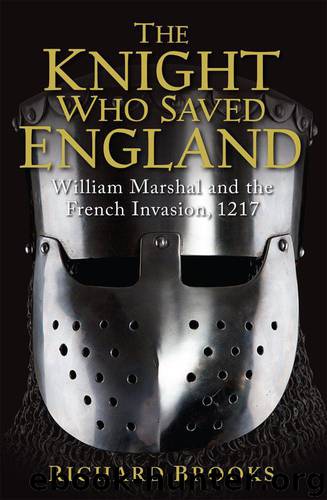
The Knight Who Saved England: William Marshal & the French Invasion, 1217 by Richard Brooks
Author:Richard Brooks [Brooks, Richard]
Language: eng
Format: mobi, epub
Tags: The Knight Who Saved England: William Marshal and the French Invasion, 1217
ISBN: 9781472808363
Publisher: Osprey Publishing
Published: 2014-04-22T00:00:00+00:00
JOHN’S LAST RIDE
For nearly two months, John lurked in Corfe Castle, on the remote and swampy Isle of Purbeck, while the shock of the French intervention wore off. Then, realising that Dover would occupy Louis for some time, John went to secure his rear in the Marches. His presence was overdue. Exploiting the unusually mild winter of 1215–16, Llewelyn had led an army drawn from all Wales to Carmarthen, which he took and destroyed after a five-day siege, ‘having expelled the French [i.e. English] not in warlike conflict, but solely from fear’ (Welsh Annals). Newport fell before Christmas, with half a dozen other castles. Only Pembroke held out. On Boxing Day Llewelyn took Cardigan and Cilgerran, both in William’s keeping: ‘whence the Welsh went home rejoicing. The French, however, sorry and everywhere driven out, were scattered here and there, like birds’. The New Year saw further Welsh gains, with the capture of Swansea Castle ‘at the first onset’, the defenders of Ros offering hostages and 1,000 marks, ‘because they could not resist’ (ibid.).
Llewelyn’s winter campaign does little for William’s military reputation. His defence might be that Wales was a side-show, its light infantry unlikely to leave the shelter of their native hills. What mattered was to hold the frontier. He was at Hereford in July 1216 to join John’s counter-offensive, the Dunstable annalist claiming that they ‘took and destroyed the castles of Reginald of Braose [Giles’s nephew] and his other enemies in the Welsh Marches’. The Welsh Book of the Princes was less positive: John ‘came to Hereford accompanied by many armed men’, and ineffectually summoned Reginald and his allies to make peace, ‘after which he burned, ravaged, and destroyed Oswestry’.
Back at Corfe on 25 August, John set off next day to relieve Windsor, already past the average term of a siege. He was at Reading on 6 September, 18 miles (27km) up the Thames from Windsor. Anonymous of Béthune claims that the opposing armies were so close that John’s Welsh archers shot into the rebel camp by night, ‘inspiring great fear’. When the rebels offered battle, John veered off north of London to ravage their East Anglian estates, as William had thought he might back in 1194. Burning their engines, the barons followed, John retreating before them:
And wherever he came across the lands of his enemies in this march, he gave them over to plunder; and they were given over to burning and food for the flames, so that our age cannot remember such fires to have been made in our part of the world in so very short a space of time.
(Barnwell)
Monasteries were particularly targeted, as dissident refuges. The day after Michaelmas (30 September), Savari of Mauléon’s men:
… came unexpectedly to Crowland [in the Fens], and not finding there those whom they wanted, burst into the monastery. Knights and horses charging through the church, cloister, and monastic buildings, they seized men from the very altar itself, amidst the holy sacrament of the Mass, and dragged them from the church.
Download
The Knight Who Saved England: William Marshal & the French Invasion, 1217 by Richard Brooks.epub
This site does not store any files on its server. We only index and link to content provided by other sites. Please contact the content providers to delete copyright contents if any and email us, we'll remove relevant links or contents immediately.
| Africa | Americas |
| Arctic & Antarctica | Asia |
| Australia & Oceania | Europe |
| Middle East | Russia |
| United States | World |
| Ancient Civilizations | Military |
| Historical Study & Educational Resources |
The Radium Girls by Kate Moore(12036)
100 Deadly Skills by Clint Emerson(4932)
Rise and Kill First by Ronen Bergman(4797)
The Templars by Dan Jones(4695)
The Doomsday Machine by Daniel Ellsberg(4493)
The Rape of Nanking by Iris Chang(4224)
Killing England by Bill O'Reilly(4008)
Stalin by Stephen Kotkin(3973)
Hitler in Los Angeles by Steven J. Ross(3949)
12 Strong by Doug Stanton(3554)
Hitler's Monsters by Eric Kurlander(3348)
Blood and Sand by Alex Von Tunzelmann(3207)
The Code Book by Simon Singh(3197)
Darkest Hour by Anthony McCarten(3135)
The Art of War Visualized by Jessica Hagy(3014)
Hitler's Flying Saucers: A Guide to German Flying Discs of the Second World War by Stevens Henry(2759)
Babylon's Ark by Lawrence Anthony(2686)
The Second World Wars by Victor Davis Hanson(2529)
Tobruk by Peter Fitzsimons(2521)
